
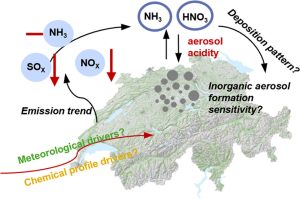
ReCLEAN researchers from EPFL recently published a new study investigating long-term changes in aerosol acidity and reactive nitrogen deposition across Switzerland. By analysing air quality observations from 2008 to 2024, the researchers found that emission controls have successfully reduced particulate matter pollution. However, ammonia emissions remain largely unchanged and continue to be the main contributor to nitrogen deposition in ecosystems, posing increasing environmental challenges. The findings highlight the need for coordinated reductions of both nitrogen oxide (NOₓ) and ammonia (NH₃) emissions to protect air quality and ecosystem health. The full article can be found here.
Abstract
Aerosol acidity is a key regulator of atmospheric processes, influencing particulate matter (PM) composition, toxicity, and the deposition of reactive nitrogen (Nr) to ecosystems. Emission controls in Europe have strongly reduced SOx and NOx but left NH3 largely unchanged, creating an imbalance between acidic and basic species that could shift aerosol pH and its impacts. Thermodynamic analysis of long-term observations (2008–2024) from Swiss monitoring sites combined with SHapley Additive exPlanations (SHAP) quantified aerosol pH and its key drivers. Annual mean pH shows a slight increasing trend, with consistently lower values in summer than in winter. SHAP analysis indicates that temperature drives seasonal pH variability at agricultural sites, whereas total ammonia (NH3T) dominates at the semialpine site. The Nr deposition analysis shows that the fast deposition of NH3T predominates across both the lowland and Alpine regions, which increases local soil nitrogen burden. In contrast, PM has become increasingly insensitive to NH3 and more sensitive to HNO3, particularly in the agricultural sites. These results highlight that, although HNO3 precursor controls have effectively reduced PM pollution without the need for NH3 reductions, evermore significant ecological concerns remain from a lack of NH3 control. This underscores the need for coordinated reductions in both NOx and NH3 emissions.